• Kids in clogs

    drawings

    I’m currently working with a brilliant artist called Yu-Chen Wang on a short piece of Turing-inspired science fiction for her upcoming exhibition at Manchester’s Museum of Science and Industry. Along with Sarah Baines, a MOSI curator, we’re writing a story that explores the interior lives of four items in the museum’s collection. The finished text will be printed by Linotype (exciting!) and presented with the rest of Yu-Chen’s installation next March.

    I’m so chuffed to be part of this project, not least because Yu-Chen’s art demonstrates a quiet obsession with more-or-less obsolete machinery and its weird beauty – something I’m approaching with my own stuff at the moment. Lots of her work explores fantastical equipment, whose uses seem unknown, and strays well into science fictional territory – biomechanics, symbiosis, memory and retelling. But on a visceral level it also highlights a simple fascination with how mechanical things work. You get the impression she’s seen and loved the way a piece of equipment looks, or moves (or both) and wants to pull it to pieces to try and understand it. Or maybe to repurpose it, craft her own reasons for it.

    To be honest, I think lots of writers, me included, often look at the produce of handiwork and the specialised trades with reverence. Not only does it feel like these people get more sunshine and exercise, but the objects they engineer are often so delicate, intricate, improbable, they’re more like mathematical dreams, somehow remembered in the morning and translated into reality. When you see them in motion, all those parts in symphony, you think, How the frigging hell did someone think of that? How did they even begin to design it? How can someone’s mind be so effortlessly practical? And then you just have to step back and marvel at their ability to pull it off; fabricate cold equipment that works with such grace that you can’t quite believe it was made by humans at all.

    From another angle, someone might say something similar about the process of writing a story or a piece of music. But I can’t help thinking that if writers sit down and create new worlds with words, engineers somehow manage to create entire galaxies with their parts, castings and fastenings.

    Anyway. Today Yu-Chen and I caught an early train up to MOSI to explore its collections and archives. The site is home to the world’s first passenger railway station, and holds within its bounds a full range of steam engines, locomotives, cotton processing plant, vacuum tubes, colliery salvage, fossilised computers – each piece kept in stasis, trophies of the industrial revolution and the years beyond it, and all so lovingly catalogued. As Yu-Chen put it, they’ve got a whole genealogy of Linotype machines down there in one store, their frames massive yet precise, their alien keyboards fixed to cast-iron exoskeletons. We poked and prodded around them in awe – admitted that these things alone would satisfy anyone with a machine-fetish. (One still had the remnants of a cigar in a tray, as if the operator had put it down while they nipped off to make a fresh brew.)
    lino

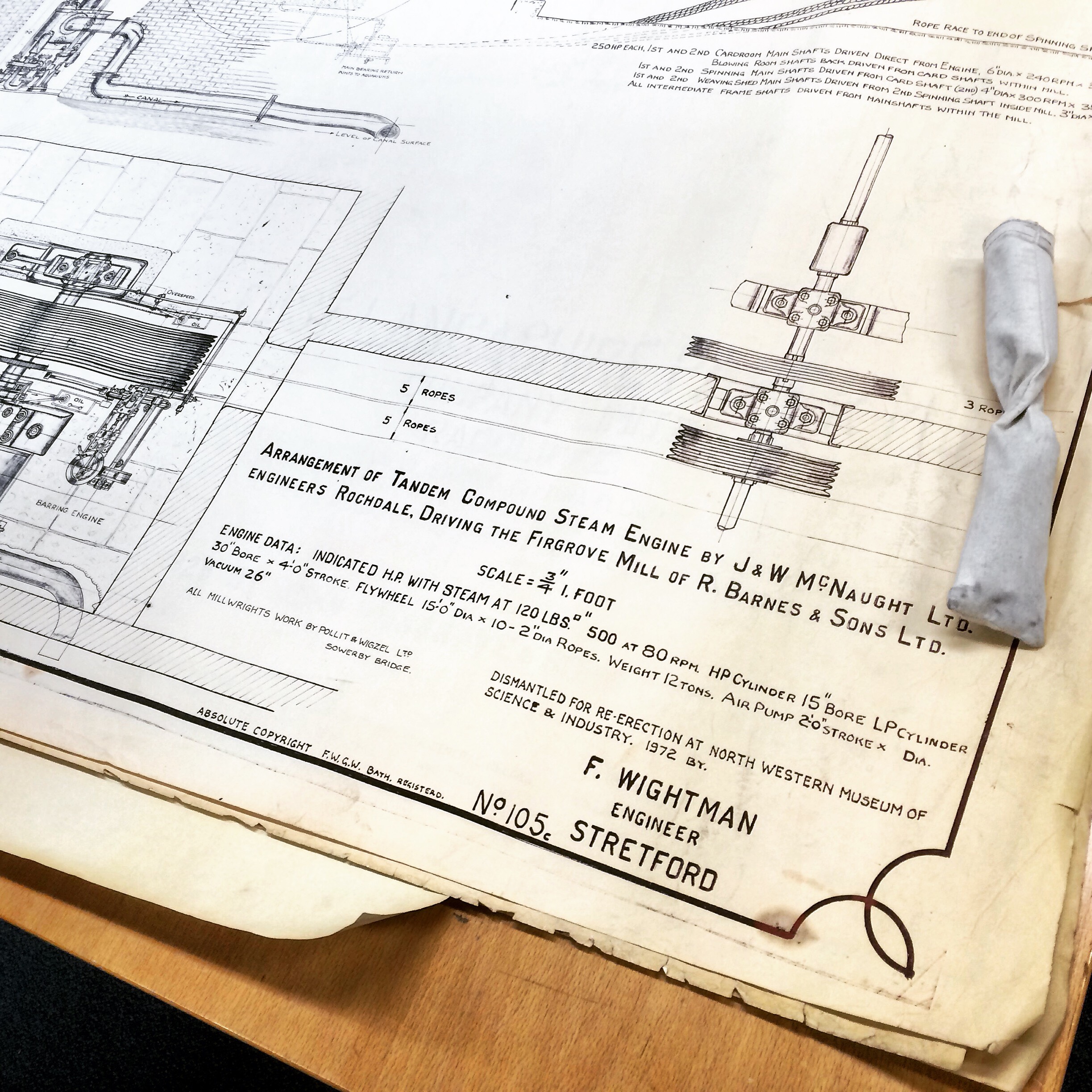
    Strangely, though, the highlight of the trip was actually the documents store. Here a lovely archivist called Jan went and fetched a ream of technical drawings by a man called Frank Wightman, and unfurled them on a wide table.

    A Stretford engineer and millwright, Wightman’s work recorded in monochrome the boiler engines and assorted installations he helped to dismantle and re-site at the museum as Cottonopolis began to fragment. I really can’t explain how sublime these drawings are: the linework is faultless, the detailing ridiculous. God knows how many hours the bloke must’ve put into them, or (as with the machines themselves) where he might have started. But more than inspiring, they were touching: apart from his all-caps, evenly spaced writing (such an engineer), and his clean, no-nonsense prose, he’d peppered each page with little annotations that hinted at a dry humour, an awareness of his talent, and a recognition that if the world was about to change and leave people like him behind, he’d damn well make sure they had something to remember it all by.

    My favourite of these drawings depicted a man’s workshop in Hollinwood. To get power to his machine tools, which he needed to repair mangle rollers, the man had driven a shaft system out into his shed and mounted it with bicycles. Not being able to afford their own bikes, the local kids would go mad for the opportunity to ride them – so they’d come along, get on, receive their ‘speed instructions’ from ‘t’gaffer’ and pedal for half an hour at a time – more than long enough for him to ‘parallel and end’ a pair of rollers.

    At the end of this great story was an even greater line: ‘Horses turned machinery everywhere, dogs earned their keep on driving manor house roasting spits, but kids in clogs drove a wood lathe in Hollinwood.’

    I bloody love that.

  • GRAFT to Angry Robot

    Y 2

    I’m proud and giddy to announce that Angry Robot Books has picked up my second SF novel, Graft.

    Set in the same alt-future Manchester as The Folded Man (but seven years on, and, save a few familiar faces, not a sequel), Graft follows a local mechanic called Sol who’s caught up in a human trafficking conspiracy when he finds a three-armed woman called Y.

    Graft will be published as a paperback original and ebook in the UK and US in early 2016. And if the rest of Angry Robot’s books are anything to go by, it’ll look flipping ace too.

    The official Angry Robot announcement is over here, and on The Bookseller here, but unofficially I can say it’s blissful (and a bit terrifying) to know it’s going to be on the shelves and (hopefully) in readers’ hands. This novel’s been a long time in the works, and I can’t wait to share more.

  • Dredging

    The other week we met a man who sells ‘ballast water management systems’ to shipping operators.

    A challenge with global shipping, he told us, is that big vessels tend to dredge a lot of marine biology into their ballast tanks as they cross the world’s oceans. This means ships can easily introduce invasive species to new areas when they dump their ballast before docking.

    I said I hadn’t really imagined this could be a thing, and that it sounded like interesting work. The salesman smiled and told us that because all this stuff happens beneath the surface – because you can’t see it – people just don’t think about it. ‘But the pump pipes have openings like this,’ he said, and held his arms out wide. ‘And the tanks can hold a lot of creatures.’

    I asked him if they simply put a mesh on the inlets, or installed some kind of filtration equipment.

    ‘No,’ he said, and paused. ‘We just kill everything with chemicals.’

    The conversation fizzled a bit after that. But I did come away with a reminder that you can find science fiction in almost anything.

    Anyway: happy new year!

  • Roadtrip

    Megacities, uncanny valleys and alien moonscapes — all from our roadtrip up the west coast of America.

    DSC_0078DSC_0922DSC_0030DSC_0218 2DSC_0076 2DSC_0289 2DSC_0439 2DSC_0541 2


  • Saying sorry

    Writers’ loved ones are the world’s most patient people — after taxi drivers in the arrivals lounge, anyway. They really deserve so much better than the crap they get served by writers in full-blown writing mode, word-wangling somewhere up their own W-hole.

    Here’s a customisable letter of apology the average writer can use to start building bridges with their nearest and dearest.

    —

    Dear [housemate / parent / husband / wife / girlfriend / boyfriend / child / neglected pet]

    I’m writing to say sorry for writing. I know you think my withdrawal from [our relationship / the normal world / this plane of consciousness / sociable activities / your needs] is because I’m moody or fed up with you or something. Well, I’m not. Truth is, it’s all because I realised (please choose all that apply):

    (more…)

  • Hope

    Image

    If there is hope in this novel – and I think there is – it lies in the resilience of Manchester and its people – people like Brian – in their refusal to have others run their lives for them. The one thing Brian will not let go of is his love for Manchester, and from time to time, through his eyes, we glimpse moments of a future in which the broken city he calls his home will rise from its ashes.

    — from Nina Allan’s brilliant review of THE FOLDED MAN. (One I’ll really, really treasure.)

  • What goes up

    Image

    After cosmic launches in Waterstones and Daunt Books, I’ve had a few quiet days to smile about everything in the world, ever.

    Now the book’s out, surreal is the main theme: it’s done, it’s out, it’s on its way. It’s in people’s hands — a few strangers’ hands, even. And there are so many lovely things to replay; to feel so lucky about. Walking to Daunt Books in posho west London and seeing that window display was trippy, dizzying. Heading into Deansgate Manchester — where I’ve always daydreamed about having a book on a shelf — and being shown to our event room… The amazing Caroline Smailes interviewing me.

    And then you read back over your messages. I’m so flipping grateful for the support, the tweets, the emails I got, and for the reviews it’s had already — here in The List, here on Litro, here on Craig Stone’s blog, a few kind souls on Amazon. (While we’re at it, I’m over on Caroline’s blog talking about Manchester, too.)

    But there’s a little but. There’s a slight comedown. A tiny weeny bit of fear about how certain people will take it. There’s also a question: What next? Because loitering behind this screen there’s another novel waiting to be finished. The feeling that this one’s sailed, but there’s another broken ship waiting in the dock.

    Anyway, I’d go on some more, but Laura Lam already nailed it all down in a beautifully frank blog post this week. So have a gander at that instead.

  • P-Day

    photo (4)


    Brian’s been released into the wild, with analogue and digital versions on the shelves and available online.

    Big thanks to the Sandstone Press team for all the hard work they’ve put in.

  • First review

    … takes aspects of many genres and combines them with staccato sentences that punch with such precision that the experience of reading the novel borders on the delirious. Quite simply, The Folded Man reads like Coetzee with ADHD.

    Dan Ellis, probably better known as @utterbiblio, has written a belting review of THE FOLDED MAN for Litro magazine. Dan gets right into the guts of the book (bad language, aggression and nastiness included) and comes out the other side with some very lovely stuff to say. ‘Chuffed to bits’ doesn’t really cover it.

  • A wild book appears

    TFMc


    For a smallish lump of squashed, sliced, graffitied tree, this beautiful-looking thing causes one of the weirdest feelings. Or even twelve of them at the same time: chufties, relief, embarrassment, hope, fear, pride, anxiety, awkwardness, gratefulness, nakedness, bewilderment, gratitude.

    To be honest I’m still waiting for Jeremy Beadle to bob over and show me where all the hidden cameras are. But if he doesn’t show up, there will be wine. So come and help me launch the bugger at Waterstones Deansgate, Manchester on 16th May, or Daunt Books Holland Park, London on 22nd May. I’ll be there, pretending as though I have a single clue what I’m doing.